

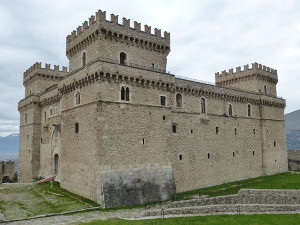
 The Piccolomini Castle of Celano is one of the most famous castles in the center of Italy. The building we know today was built from the fourteenth century, but on the basis of a pre-existent wooden and dotted structure. The whole building is protected by an outside wall, as well as a moat with a drawbridge that allows access to the castle. Between the walls of the central building a rectangular plant extends over a vast courtyard surrounded by a large two-story porch of the Renaissance. Of the rich ornamentation inside we remain unfortunately exclusively from testimonies of past authors who admired the frescoes kept in the walls of the fortification, destroyed after the earthquakes of the 1800s.The Piccolomini Castle of Celano is one of the most famous castles in the center of Italy. The building we know today was built from the fourteenth century, but on the basis of a pre-existent wooden and dotted structure. The whole building is protected by an outside wall, as well as a moat with a drawbridge that allows access to the castle. Between the walls of the central building a rectangular plant extends over a vast courtyard surrounded by a large two-story porch of the Renaissance. Of the rich ornamentation inside we remain unfortunately exclusively from testimonies of past authors who admired the frescoes kept in the walls of the fortification, destroyed after the earthquakes of the 1800s.
Il castello Piccolomini di Celano è uno dei castelli più noti del centro Italia. L'edificio che conosciamo oggi è stato realizzato a partire dal quattordicesimo secolo, ma sulla base di una struttura preesistente in legno e terra battuta. L'intero edificio è protetto da una cinta muraria esterna, oltre che da un fossato dotato di ponte levatoio che consente di accedere all'interno del castello. Tra le mura dell'edificio centrale a pianta rettangolare si estende un vasto cortile circondato da un ampio porticato a due piani di età rinascimentale. Delle ricche ornamentazioni interne ci restano purtroppo esclusivamente delle testimonianze di autori del passato che ammiravano gli affreschi custoditi tra le mura della fortificazione, andati distrutti in seguito ai terremoti del 1800.